We believe it is vital to keep our clients informed concerning the major lending sources in the market. We asked a few of our producers in our LA office to call our lenders and provide insight into how these various lending segments are performing in the market. Keep reading below to find out more:
Life Insurance Companies:
Life Insurance Companies continue to be the most consistently active lenders regardless of market conditions. They generally are more conservative from a leverage perspective, preferring lower-leverage deals in any environment. This strategy allows them to continue to lend on good real estate with strong sponsors in a down market. Several of our Life Insurance Companies mentioned breaking records during 2023 while everyone else was, on average, ~50% down in production.
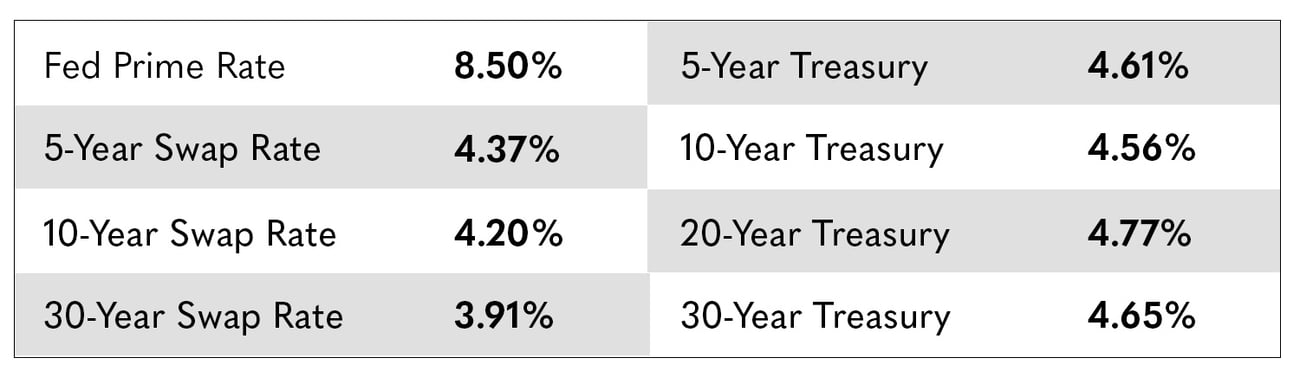
Rates can range from a 1.30%-1.40% spread above the corresponding Treasury for well-located, low-leverage, high-quality deals with strong sponsorship, all the way up to a mid-200s spread for deals that don’t definitively check all of those boxes. Retail seems to be a preferred asset class. Multifamily and industrial are always on lenders’ radars. Self-storage and medical offices are asset classes we are seeing more demand for. Office lending with our Life Co's is limited to suburban offices with granular rent rolls, strong operating history, and strong sponsorship. Because of what was, in general, a down year last year, many Life Co's are venturing into either bridge or construction financing. While most of our Life Co's offer non-recourse financing, other structures of particular interest to our borrowers include interest-only, prepayment flexibility, and other out-of-the-box things like forward rate locks. Interest only is usually more widely available on lower leverage deals (not always the case). Prepayment flexibility is accomplished with an add-on rate. Forward rate locks were more popular when rates were lower but are still available for deals that may fit, such as apartment construction take-out deals. The term can be anywhere from three years to fully amortizing over 25. There is a lot of demand for shorter-term money as many borrowers think rates will fall, and our lenders do their best to adjust to that demand.
-Jonny Soleimani, Vice President
Agencies:
Fannie and Freddie are fielding high volumes of new loan requests and quoting deals but the conversion rate of quoting to signing up business is low. Fannie is behind Freddie on annual production volume, so Fannie is pricing more aggressively on lower leverage (sub 50-60% LTV) deals with spreads as low as 125-135bps over the treasuries with some affordability component with a 10bps premium assuming no affordability. Fannie is actively and aggressively quoting their “near stabilization” program for multifamily properties that are within 4 months of stabilization, which does not require the typical 90/90 occupancy rule.
While Fannie is aggressive on lower leverage deals, Freddie is the preferred product for higher levered 1.25/x/75% LTV deals, regardless of any mission-driven components, pricing in the 155-185bps range depending on the sponsor, deal quality, and other deal-dependent details.
To summarize, both agencies are actively quoting new deals but not closing a ton of business with Fannie more aggressive on lower levered deals and Freddie focused on higher leverage deals.
-Grady Seldin, Vice President
Debt Funds:
Current regional and national banks are facing deposit issues that are tightening their lending and causing them to pull out of the market. There is competition in the debt fund space among lenders with lots of capital that needs to be allocated into the marketplace. We're seeing deals fall out from regional/national banks seeking faster closings and borrowers needing higher leverage, anywhere between 65-75% of cost. Current rates range from 3.75-4.50% over SOFR today at 65-75% of cost. Terms from deals range from 2-3 years but primarily with two years of interest only with funds taken out in year three upon a capital event, refinance, or sale.
-Will DeFanti, Vice President
Credit Unions:
Currently, most credit unions are underwriting loans with a minimum debt service coverage ratio (DSCR) of 1.20/1.25 and a maximum loan-to-value (LTV) ratio from 50% to 70%, typically on a 25/30-year amortization schedule. The specific terms may vary depending on the nature of the asset, whether it's retail, multifamily, or industrial.
Interest rates for these loans are typically set above the Constant Maturing Treasury Index, resulting in all-in coupons ranging from 6.5% to 7.50%. However, these rates are subject to change based on LTV, type of real estate, and prevailing market conditions.
It's important to note that these underwriting criteria are not set in stone and can be influenced by factors such as the borrower's net worth, experience level, property location, and the quality of the real estate.
-Tony Messiah, Vice President
CMBS:
The CMBS origination and secondary market is relatively healthy. The demand from the secondary market is outpacing supply as pricing still provides some level of sticker shock. We continue to see heavy scrutiny for office deals and non-credit retail. However, for deals with credit and strong economics, the traditional 65% LTV full interest-only is available. The pricing efficiency for full-leverage CMBS loans covers a wide spectrum, from the mid-200s to mid-300s over the treasury. For sub 60% LTV CMBS execution, spreads can be in the low 200s which can be very attractive on a full I/O term. Office deals are heavily scrutinized and will require substantial reserves. Industrial and multifamily can be sized to tighter DSCRs than other product types.
-Jacob Lee, Vice President